Tonight, Saturday, March 20, the first of the Pocatello-Chubbuck Observer sponsored Liberty Dinners will be held, starting at 6:00 p.m. at the Bannock County Veterans Memorial Building.
The Liberty Dinner series is an opportunity for those concerned about the erosion of Constitutionally protected freedoms and government excess to hear from those working to preserve Idahoans’ rights while supporting the promotion of Americanism and patriotism with our youth.
Part of the proceeds from tonight’s event go toward the AMVETS Americanism Contest, which features opportunities for young people in grades K-12 to learn about America and to create essays and posters for the competition. Last year, hundreds of dollars in prizes were awarded to local students in the AMVETS Idaho Post 1 local area contest. See article, here:
Tickets for tonight’s dinner are still available. Reservations are encouraged, as seating is limited. To reserve a spot, contact John Crowder at (925) 628-4033, or via email at jcrowder27@hotmail.com.
Like and Follow the Pocatello-Chubbuck Observer on Facebook and/or MeWe to learn about future events.
Earlier this week, Boise State University issued the following statement regarding the recent suspension of UF 200 classes:
We have been made aware of a series of concerns, culminating in allegations that a student or students have been humiliated and degraded in class on our campus for their beliefs and values. This is never acceptable; it is not what Boise State stands for; and we will not tolerate this behavior.
Given the weight of cumulative concerns, we have determined that, effective immediately, we must suspend UF200. In conjunction with academic leadership, we will determine next steps to ensure that everyone is still able to complete the course over the coming week and will communicate with all students in these classes. While an in-depth review of this course was already underway, we must be responsive to these specific allegations and ensure that this and all our courses live up to this standard of mutual respect.
Further, we will develop and deliver a series of professional development sessions for faculty on fostering learning environments characterized by mutual respect.
Finally, we have created a purpose-specific mid-term evaluation for students in UF200 that will invite all enrolled students to share their experience as members of the course community. As always, students have multiple options for reporting instructor bias, including anonymous reporting.
Boise State University is committed to ensuring that each and every one of our students is treated with respect, and that all have the right to hold and to voice their own personal and political beliefs. Our campus is richer, and learning is made more effective because people of all backgrounds and beliefs are invited to meet, exchange ideas, and learn together.
Boise State students have multiple options for reporting, including:
(National Association of Scholars Press Release, March 4, 2021)
New York, NY, March 4, 2021 – Colleges and universities have facilitated a massive transfer of wealth from American families to higher education bureaucracies through rising tuition and student debt, finds a new report by the National Association of Scholars.
Priced Out: What College Costs America details the spending habits of 50 universities and shares the worries, thoughts, and hopes of students, parents, and college administrators to investigate the psychology behind students’ decisions to take on overwhelming debt and the choices administrators make in spending that tuition. The report also offers recommendations to reform America’s student loan system by encouraging colleges and universities to have skin in the game, to focus on instruction, and to discourage credentialism as a stand-in for experience.
“Many colleges and universities spend beyond their means to attract more students and increase their institution’s ranking. This is wrong,” explained report author and NAS researcher, Neetu Arnold. “In an effort to fill budget gaps, colleges need to attract more students. They do this by spending more on facilities and administrators, but rarely on instruction. This necessitates tuition increases, which forces students who attend college to take on more debt. The feedback loop is further helped with government subsidies.”
Mrs. Arnold’s analysis of 50 colleges and universities found that:
Tuition increases at public universities far exceeded their losses in state funding; in other words, state disinvestment cannot be the sole cause of rising tuition. Administrators mostly used tuition increases to pay for increased university expenditures.
The total number of administrators and staff grew by roughly 50% between 1987 and 2018, driven by a 94% increase in the “Executives” and “Other Professionals” categories.
Universities devoted increasing amounts of their resources to government relations, marketing, and public relations, at the expense of undergraduate instruction.
Peter Wood, NAS president, noted: “Over the last four decades, tuition in American universities has grown exponentially in terms of what families make in yearly income. Worse, these increases in tuition have not equated to more or better instructors. These facts alone signal a system failure. Colleges and universities should act to reform themselves. If they are unwilling, Congress and state legislatures should step in to provide common-sense reforms.”
Priced Out concludes with 14 recommendations to refocus higher education on undergraduate instruction, to reduce administrative bloat, and to provide families with incentives to make more fiscally responsible choices as they decide which college students should attend and how much debt they should incur. These recommendations include:
Universities should consolidate offices and departments to reduce duplicate roles.
Universities, particularly public institutions, should create 2-3 year vocational tracks, with classes staffed by industry veterans.
Universities should have “skin in the game” when students borrow loans and assume responsibility for a portion of loans when students default.
Federal and state governments should cut funding to four-year universities that provide remedial education and related services.
State governments should make public university employee salary information publicly available and easily accessible.
In the wake of the financially devastating coronavirus pandemic, universities can no longer ignore their profligate spending habits. Higher education’s finances must be reformed.
NAS is a network of scholars and citizens united by a commitment to academic freedom, disinterested scholarship, and excellence in American higher education. Membership in NAS is open to all who share a commitment to these broad principles. NAS publishes a journal and has state and regional affiliates. Visit NAS at www.nas.org.
WASHINGTON – Today, U.S. Senator Jim Risch (R-Idaho) reintroduced bipartisan legislation to improve underserved states’ ability to successfully compete for Small Business Innovation Research (SBIR) and Small Business Technology Transfer (STTR) awards.
The FAST Fix Act will reform the Small Business Administration’s (SBA) Federal and State Technology (FAST) Partnership Program to encourage federal research and development grants to be awarded to small businesses and universities in states that have historically lacked SBIR and STTR awards. If enacted, this bill would encourage more awards to commercialize ideas, compete in the global marketplace, and create local jobs. The FAST Fix Act is cosponsored by U.S. Senators Mike Crapo (R-Idaho), Jacky Rosen (D-Nev.), John Hoeven (R-N.D.), Catherine Cortez-Masto (D-Nev.), Shelley Moore Capito (R-W.Va.), John Kennedy (R-La.), and Lisa Murkowski (R-Alaska).
“The FAST Partnership Program is not sufficiently focused to reach the underserved states it’s intended to benefit,” saidSenatorRisch. “The FAST Fix Act will make commonsense changes to the program application process to ensure research and development grants reach states like Idaho to galvanize our continued growth and success.”
“The FAST Partnership Program helps next generation research and development small businesses prevail,” saidSenatorCrapo. “The FAST Fix Act will bolster competition for FAST grants in rural states like Idaho and encourage more participation in the grant programs to help certain small businesses reach their full potential.”
“Nevada small businesses are the engine of our economy and particularly during this period of economic uncertainty, we must do more to help small businesses access SBIR and STTR award opportunities,” saidSenator Rosen. “I’m proud to support this important piece of bipartisan legislation that will open the door for more funding opportunities to Nevada’s hard-to-reach communities to support innovation and job growth. I will continue working in Congress to strengthen economic development in underserved areas of the Silver State.”
“Rural states like North Dakota will benefit from the FAST Fix Act as it aims to give states that have been less likely to receive SBIR and STTR awards a fair shot moving forward,” saidSenator Hoeven. “This will help encourage research and development, make us more competitive in the global marketplace and create local jobs in less-populated states like ours. It’s important that we continue to expand economic opportunities and help entrepreneurs and small businesses recover from the COVID-19 pandemic.”
“As part of my Innovation State Initiative, I’ve been working to help Nevada’s economy diversify and further develop its cutting-edge industries for the 21st century,” saidSenatorCortez Masto. “The FAST Fix Act will help small businesses, startups, and research institutions all over the Silver State get key federal grants to pioneer creative new technologies and approaches.”
“It’s important underserved areas like those in West Virginia are not left behind when it comes to federal grant funding for small businesses and universities,” SenatorCapito said. “Investing in our local communities will bring more jobs, and these grants can serve as a catalyst for economic growth. The FAST Fix Act would do away with the one-size-fits-all bureaucratic process, and help SBA better fulfill its mission of serving community employers and workers.”
“States like Louisiana use FAST grants to help small businesses succeed, but the program’s assistance is not reaching communities that rely on these resources to spark innovation. The FAST Fix Act would prioritize applicants in historically underserved areas in Louisiana and elsewhere. I’m proud to partner with Sen. Risch to see this through,” saidSenatorKennedy.
“The FAST Partnership Program is intended to aid disadvantaged, research and development focused small businesses. But over the life of the program, Alaska has consistently ranked at the bottom of the list of states getting awards – demonstrating the program is not working for Alaska and other states. The FAST Fix Act implements small but significant changes to the program to improve funding allocation and give higher priority to applicants in historically underperforming, states such as Alaska,” said Senator Murkowski. “Reforming this partnership is an important step toward maximizing the innovation of Alaskans.”
Background: The FAST Partnership Program provides one-year funding to organizations to develop SBIR/STTR outreach and training programs to help facilitate more awards in their state. Special consideration is intended for entities in states that have historically lacked awards. However, under the one-size-fits-all application process, all applicants are equally considered for the FAST program regardless of SBIR/STTR award history. As a result, the program is not penetrating the very states it’s intended to serve.
The FAST Fix Act would increase competition for FAST grants in each state and give priority to applicants located in historically underperforming states to encourage more SBIR/STTR awards are distributed to underserved areas.
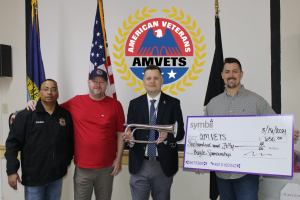
L – R Miguel Dominic (AMVETS Honor Guard Cmdr), Lance Kolbert (AMVETS Cmdr), Terrel Tovey (Bannock County Commissioner), Rob Mackesey (Symbii Director of Marketing) Photo Credit: AMVETS FB Page
Thanks to a generous donation of $650 from Symbii Home Health and Hospice of Idaho, AMVETS Idaho Post 1 Honor Guard now has an electronic bugle to use in the performance of their ceremonial duties.
The local AMVETS chapter expressed their appreciation for the donation on their website. They posted, “On behalf of AMVETS Post 1 and AMVETS Honor Guard I would like to thank the good folks at Symbii for their donation of $650 for the Honor Guard Electronic Bugle.
Your donation will help our Honor Guard bring a high level of professionalism and honor to our veterans and their families.
March 19, 2021 (Photo Credit: NewsTalk 107.9 Facebook Page)
Idaho District 34 Representative Ron Nate
On Wednesday, March 17, Representative Ron Nate (R-Rexburg) was interviewed on the Neal and Julie show on NewsTalk 107.9 regarding the social justice controversy at Boise State University (BSU).
Earlier this week, BSU suspended UF 200 classes following student complaints. Members of the legislature have expressed concern about the classes promoting social justice ideology.
Today, Representative Nate posted the following on his social media:
“It’s official, BSU admits to systemic Social Justice / Critical Race Theory problems on campus and how some students are being targeted. They shut down all their University Foundations 200 courses, and instructed students on how to file grievances and complaints about mistreatment they may have endured in those courses or elsewhere on campus.”
A video of the interview can be seen on the NewsTalk 107.9 or the Nate for Idaho Facebook pages.
March 17, 2021 (This article first appeared on the Idaho Freedom Foundation website)
Did “White Privilege” Lecture Cause the Cancellation of BSU’s Social Justice Courses?
By: Idaho Freedom Foundation Vice President Dustin Hurst
Idaho Freedom Foundation Vice President Dustin Hurst (Photo Credit: Idaho Freedom Foundation)
On Tuesday, Boise State University suspended all 35 of its University Foundations 200 classes. Administration explained, “a student or students have been humiliated and degraded in class on our campus for their beliefs and values.”
BSU President Marlene Tromp and Interim Provost Tony Roark told students that classes would be suspended “while the university gathers more information.” Tromp and Roark indicated students will still be required to complete their UF 200 courses once “next steps” are determined.
UF 200, otherwise known as Foundations in Ethics and Diversity, is among four mandatory general education courses that are infused with social justice, a toxic ideology that has captured many facets of life at Boise State.
While Tromp and Roark didn’t cite a specific incident that caused the suspension, a BSU employee may have spilled the beans on social media.
Dr. Kyle Boggs, an assistant professor in BSU’s English Department, tweeted Tuesday that a white privilege lecture may have sparked the school’s actions.
Wrote Boggs on Twitter: “A student in a university foundations class taped a zoom discussion on white privilege, in which apparently a white student was made to feel uncomfortable, and sent the video to ID state legislature, who are ‘enraged.’ BSU suspended all UF 200 classes mid semester as a result.” (The tweet can be seen on the IFF website.)
Boggs has since deleted the tweet without explanation. IFF emailed Boggs several questions about his now-erased tweet, but he has not responded.
IFF contacted several legislators in search of the video Boggs mentioned, but none have seen or received a video.
Mike Sharp, BSU’s director of media relations, says the school has not seen a video if one exists. Sharp, in a phone call with IFF, reaffirmed that the suspension of UF 200 classes came after several complaints about the courses, not one specific incident.
The course suspension comes just hours before the Idaho Senate’s vote on Boise State’s budget. Budget writers on the Joint Finance-Appropriations Committee propose to cut a mere $400,000 from BSU’s budget in order to send BSU a message about the school’s focus on social justice programming. The Idaho Senate will likely vote on the higher education budget Wednesday.
Two conservative lawmakers — Rep. Ron Nate of Rexburg and Rep. Priscilla Giddings of White Bird — have criticized the miniscule budget reduction for BSU. “There’s no message being sent here,” Nate warned in an Idaho Freedom Foundation video posted Monday. Nate and Giddings have suggested cutting BSU’s budget by between $2.5 million and $20 million to send an effective message to the school.
Idaho Freedom Foundation Legislative Affairs Director Fred Birnbaum has also criticized the small proposed cut. In an Idaho Spending Index analysis of the higher education budget, Birnbaum put the reduction into perspective. “When you consider that BSU’s total operating budget, including non-appropriated funds that come directly from the federal government, is over $600 million, a cut of less than a half-million dollars is hardly a dent,” Birnbaum wrote in his analysis.
If the higher education budget, which sets spending plans for BSU along with Idaho State University, the University of Idaho, and Lewis-Clark State College, clears the Senate floor Wednesday, the House of Representatives could take up the proposal as early as Friday.
The Idaho Freedom Foundation has requested copies of the student’s UF 200 video recording, and this story will be updated as we receive more information.
(Idaho Governor’s Office Press Release, March 18, 2021)
Governor Brad Little (Official Photo)
Boise, Idaho – During a press conference today, Governor Brad Little emphasized the need to direct the billions of dollars allocated for Idaho from the American Rescue Plan Act (ARPA) into long-range investments that will benefit our grandchildren – the generation that will have to pay off the massive federal debt.
Governor Little said he will work closely with the Legislature in allocating the funds. He said he will spend time traveling the state to meet with legislators, business groups, and others on the best ways to strategically invest the funds.
Why is Idaho accepting the new federal money?
Governor Little detailed his concerns with the massive federal spending bill but said rejecting the funds is not the right thing to do for Idaho.
“Rejecting the funds would mean California, New York, Illinois, and other big states get to spend Idahoans’ tax dollars. Rejecting the funds would mean Idaho gives up our say in how our allocated share gets spent. That is unacceptable. Therefore, Idaho will accept the allocation for our state,” Governor Little said.
How much money will the State of Idaho receive from the ARPA?
Funds to state and local governments:
$1.89 billion in discretionary funds
$1.188 billion to the state for COVID response
$126 million to the state for COVID capital projects
$347 million for county governments and $229 million for city governments
$981 million for direct programs ranging from K12 to childcare grants
Funds to Idaho citizens and businesses:
More than $2 billion in direct support to businesses and individuals, including stimulus checks and other economic support (PPP loans, support for restaurants and live venues)
What are Governor Little’s priorities in the allocation of the ARPA funds?
The funds are mortgaged from our grandchildren, and Governor Little said we should make long-range investments that will serve to better their chances and opportunities since they are burdened with paying off the debt.
One-time funds should go to one-time expenses. He said we will not create ongoing obligations that would be shifted to the General Fund once the federal funds run out.
The use of the funds also should not impede our constitutional mandate to provide a long-term, structurally balanced budget for the people of Idaho. They should do the opposite – the funds should be used to lower the state’s capital and deferred maintenance costs in the years ahead.
The funds also should not duplicate other federal programs where support is provided to specific industries or through specific programs.
Since states have nearly four years to spend most of the ARPA funds, Governor Little said we should take our time and be strategic and thoughtful about how the funds are allocated. To be prudent, we should await U.S. Treasury guidance and study the impact of other direct programs in ARPA to ensure we target support to needed gaps.
What is the process for allocating the ARPA funds in Idaho?
Governor Little said he is committed to working closely with the Legislature in the allocation of the funds.
Unlike the federal CARES Act dollars Idaho received last year, which had to be spent in nine months, states have nearly four years to spend most of the new funds.
However, some of the direct funds to agencies – mostly for K-12 public education – are legally required to be allocated within 30 to 60 days. Governor Little said we cannot wait until the next legislative session to direct these funds to our public schools.
“Therefore, I have been actively working with legislators on a plan for them to take the required actions before adjourning, while setting up a process to make long-range investments with the remaining funds,” Governor Little said.
Why is the process for allocating the ARPA funds different than how Idaho allocated the CARES Act funds last year?
Governor Little said:
“When the CARES Act funds arrived last year, we were in the throes of a crisis. We were dealing with a new virus and had little knowledge of the extent of its impacts. We had little testing, no treatments, too little PPE for hospitals and workers, and no vaccine. We needed to act quickly in deploying federal resources so we could prepare for the worst. That is why we set up the Coronavirus Financial Advisory Committee – made up of legislators and others – to recommend the best ways to use the funds to quickly respond to the crisis. We had only nine months to spend the CARES Act funds, and we did so responsibly and transparently.
“This time around, we have nearly four years to spend the new funds. This time around, we’re not in crisis mode. We’ve learned a lot about the disease, how it spreads, and how to best protect ourselves and our loved ones. We have the safe and effective COVID vaccine, the treatments to keep people out of the hospital if they catch COVID, and widely available testing and PPE.
“That is why, this time around, the situation allows us to spend more time deliberating on the best ways to use the funds to support the next generation of Idahoans who will have to deal with paying off the debt.
“We should not hastily spend the funds we receive. We should wait for guidance from the U.S. Treasury, so we responsibly allocate these resources. We must be thoughtful and deliberative in our approach,” Governor Little said.
This evening, Friday, March 19, AMVETS Idaho Post 1 will be holding a pastie feed from 4:30 p.m. until 7:30 p.m. at the Bannock County Veterans Memorial Building.
Pasties are large, savory, filled pastries. Diners will be able to choose from venison, beef, or chicken pasties. Included in the meal is a dessert of triple berry cobbler and vanilla ice cream.
The meal is available for dine-in or takeout. Cost is $10 per pastie.
The Bannock County Veterans Memorial Building is located at 300 N. Johnson Avenue in Pocatello. Entrance to the pastie feed/drive thru is in back of the building, where parking is available.
I can’t remember how many times I heard, or used, that phrase, growing up.
Even as children we instinctively knew that, although under our parents care and direction, others, especially our peers, did not have the right to, “boss us around.”
Now, life seems to have come full circle, as an increasing number of government edicts are being enacted that look to control every aspect of our lives.
If you’re one of the many residents of Pocatello, Chubbuck, or nearby environs that is tired of government overreach, plan to attend the monthly Liberty Dinner Series sponsored by the Pocatello-Chubbuck Observer. You’ll have a chance to connect with others who feel the same as you do, who believe that we need to stand up to protect, and/or restore, our God-given rights before they’re all gone.
Besides being a great networking opportunity, you’ll enjoy a catered meal and hear from speakers who are passionate about our freedoms and who are taking action to preserve them.
Hundreds of local residents attended the RECONNECT Southeast Idaho Event (Photo Credit: RECONNECT Southeast Idaho)
This Saturday, March 20, hear from Chantelle Holman, Michele Holyoak, and Ashley Smith, the founders of RECONNECT Southeast Idaho. Learn how they discovered that one person, speaking up, can make a difference, and how you can, too.
By attending, you’ll also be helping to instill the principles of patriotism in the next generation. Part of the $25 per person proceeds goes toward providing prize money for students entering the local, AMVETS Idaho Post 1 Americanism Contest.
The Saturday, March 20, dinner begins at 6:00 p.m. at the Bannock County Veterans Memorial Building, 300 N. Johnson Avenue, in Pocatello. The catered meal includes spaghetti with meat sauce, bread, salad, and dessert.
Seating is limited. To reserve your spot, contact the publisher of the Pocatello-Chubbuck Observer, John Crowder, at 925-628-4033, or by email at jcrowder27@hotmail.com.
Click on the image, below, to learn more. Also be sure to follow the Pocatello-Chubbuck Observer on Facebook so you’ll be the first to know about future events.