Saturday, September 5, 2026
Home Blog Page 9

Guest Columnist Idaho Senator Brian Lenney: Idaho’s $50 Billion Handout

0

August 22, 2026

Idaho’s $50 Billion Handout

By: Idaho Senator Brian Lenney

A guy on X posted this week that the “experts are in shock,” that Micron is putting $50 billion into Boise, that it’ll produce 17,000 jobs, and that this is huge for Americans.

We’ve spent decades being trained to cheer at numbers. A random figure gets announced, a governor stands next to a hard hat with a golden shovel, and we’re all supposed to feel something.

I have a different take:

In 2008 the legislature passed House Bill 562 to lure Areva, a French nuclear company, into building an enrichment plant near Idaho Falls. It said if you put $1 billion into the state within seven years, your taxable property value gets capped at $400 million forever.

The French never showed (shocking). But Micron hit the threshold in 2011 and took the deal written for somebody else.

By 2019 Micron’s Boise plant was assessed at $1.86 billion. Without the cap, that footprint would have owed $20.32 million in property tax the following year. Its actual bill in 2024 was $3.4 million. The new build sits under a separate entity, so it gets a second $400 million cap. Then House Bill 678 in 2022 killed the sales tax on construction materials, and Washington added $6.165 billion in CHIPS money too.

Micron passed a $1 trillion market cap this spring and has been above it since, on $90 billion of revenue at a 56% net margin. This week it announced a $10 billion AI research lab in Boise, funded out of pocket.

That’s the company we decided needed “relief.”

But wait, there’s more! In 2020 the legislature passed House Bill 521, exempting data centers from sales tax. The bar: $250 million invested within five years, and 30 permanent jobs.

That’s not a typo: 30.

Meta turned up almost immediately with an $800 million campus on farm ground outside Kuna, a town of 25,000. It has since crossed the $400 million threshold too (permanent headcount is around 100) and its record with kids is no mystery with headlines like:

What does it cost you?

A Boise homeowner pays about $300 a year more than he otherwise would, a Kuna homeowner about $160. Those are Ada County numbers and I represent Nampa, so here’s how it reaches us: the sales tax exemptions are statewide. Every dollar we forgive in Boise or Kuna is a dollar the general fund doesn’t have, and that fund pays for stuff in Nampa and Caldwell and Melba.

Call it what it is: this is a retired couple in Kuna sending money to Menlo Park, or a framer in Nampa sending money to shareholders in New York and Riyadh.

Chris Bruce and Lori Den Hartog tried to trim it back this session with House Bill 897. I voted yes. Micron objected to the part touching its property tax cap, and it died in the House.

Why these bills always die

Here’s a big part of it: dinners, receptions, drunken trips somewhere a lot nicer than Boise in January on somebody else’s plane. I get the invitations. Once in a while I’ll go to something if there’s an actual reason (but we’re talking single digits out of a hundred). Saying no to the other ninety-some is a large part of why I have time to sit here and write this.

A lobbyist isn’t a stranger to anybody in that building. He’s there every day of the session. He learns a member’s kids’ names, asks after the wife, buys dinner, drinks, and who knows what else. There’s wine and shots and drunk legislators, and by March many legislators have eaten 40 meals with their lobbyist “friends” and maybe two with their own families.

Then a bill comes up and he says what he needs, and it doesn’t land on that member as a bribe.

It lands as a favor for a “friend.”

The filing burden falls on the lobbyist, not the legislator, and most of what he files is a lump sum by category. Entertainment. Travel. Lodging. A dollar number with nobody’s name attached to it.

Then at the end there’s a banquet where a lobbying group hands out awards for being a “friend of Idaho business.” None of this is the exception. It’s how that building works, and a big chunk of the legislature takes part in it. Nobody breaks a law but somehow men who consider themselves honest cast votes they couldn’t explain at home, because the man who asked was a “friend” who bought them drinks.

Nobody asked about the jobs

But I digress…

Go read House Bill 562 and find me the part that requires anybody to hire anybody.

It isn’t in there. Section 63-4502 defines a qualifying investment as a billion dollars of construction and equipment. That’s the whole test. No employment floor, no wage standard, no residency requirement, not one word about a human being.

Buy the machines, skip the taxes, forever.

Meanwhile Micron filed 573 labor condition applications last year. H-1B doesn’t spread evenly across a new build. It concentrates in exactly the roles a kid from Nampa with an engineering degree is aiming at. Process. Yield. Integration. Design. The construction and technician jobs mostly go local while the career goes to a guy from India.

And that Indian can’t quit. His status belongs to his employer, so he doesn’t push on wages, doesn’t jump to a competitor, and doesn’t file the complaint. That’s not a knock on him. It’s a knock on a company that would rather have a workforce it owns than one it has to bargain with, the same instinct that shipped our plants to China and called it efficiency.

So about those 17,000 jobs. Maybe Micron delivers every one of them. But nothing in Idaho law says they have to, nothing says the jobs go to Idahoans, and nothing happens if the number comes in at 6,000.

We held $50 billion worth of negotiating position and asked for nothing.

What to do

I’m bringing a bill to repeal all of it. Not sunset it. Not index it. Repeal.

Title 63, Chapter 45, the $400 million cap. Written for a company that never came, passed 41 to 27, no member’s name on the bill, and they declared an emergency to backdate it. Brad Little even voted no on it when he was a legislator.

Idaho Code 63-3622VV. The data centers. Thirty jobs.

Idaho Code 63-3622WW. Read subsection 4(e): to qualify you have to already be collecting CHIPS money and already be claiming the 2008 cap. We wrote the old giveaway into the new one as a prerequisite. It’s a corporate welfare ladder, and we built every rung ourselves.

Three sections need to go.

Because a tax break for one company is a tax increase on everybody else. And a business that has to be paid to come here is coming for the check, not for Idaho. It’ll leave for a bigger one.

America First isn’t a line for a mailer…

It means the American worker comes before the shareholder, the kid from Nampa gets first look at the job in his own state, and a trillion-dollar corporation that wants our power and water and roads pays the same freight as the framer down the road and hires our kids while it’s here.

I’m tired of watching my own party act like the Chamber of Commerce with a flag pin on and what I actually want is harder to put in the tax code. I want a kid who grows up in Nampa to be able to stay in Nampa, own a house on one income, and bury his parents in the county he was born in.

That used to be ordinary here, and no press release with a big number in it is going to bring it back.

SUFI to Host Presentation on 9/11 Investigation, Wednesday, August 26

0

(Stand Up For Idaho Press Release, August 24, 2026)

Idaho Falls–This upcoming September 11th will be the 25th anniversary of the destruction of the World Trade Center towers in New York City. Roland ‘Ed’ Angle (former CEO of and board chair of Architects & Engineers for 9/11 Truth), Erik Lawyer (founder of Firefighters for 9/11 Truth), and Raul Angelo (Captain Emeritus of Ladder Co. 6, Seattle, WA Fire Department) have spoken to us about concerns with what we are being told how the towers failed and came down.

Richard Gage, AIA, is a member of the American Institute of Architects, and founder & former CEO of Architects & Engineers for 9/11 Truth. He now leads the charge for a new World Trade Center investigation along with his courageous wife Gail at RichardGage911.org

Mr. Gage will visit us via zoom and give us an update on the September 11, 2001 World Trade Center Investigations.

Mr. Gage became interested in researching the destruction of the WTC high-rises after hearing the startling conclusions of a reluctant 9/11 researcher, David Ray Griffin, on the radio in 2006, which launched his own unyielding quest for the truth about 9/11. The organization he founded, AE911Truth, now numbers more than 3,600 architects and engineers demanding a new investigation into the explosive destruction of all three World Trade Center high-rise buildings on 9/11.

As an architect, he has worked on most types of building construction, including numerous fire-proofed steel-framed buildings. Most recently, he worked on the construction documents for a $400M mixed-use urban project with1.2million square feet of retail, parking structure, and mid-rise office space—altogether about 1,200 tons of steel framing.

Come with an open mind and learn some truth about September 11, 2001 and the destruction of the World Trade Center towers.

The Westbank Conference Center, 525 River Parkway, Idaho Falls.
6:30pm (Doors open at 6:00pm)

About Stand Up For Idaho: We are a nonpartisan, nondenominational, nonprofit organization striving to inform and educate the public on a wide range of topics that affect people’s lives. We advocate for the common good, well-being, and civic betterment for all Idahoans, and for the rights and liberties guaranteed by the Constitution of the United States and the Constitution of the State of Idaho.


Pocatello PD’s 10 Days of Back-to-School Safety: Crosswalk Safety

0

(Pocatello Police Department, August 24, 2026)

Drivers and pedestrians both have a role in keeping crosswalks safe.

Pedestrians:
• Use designated crosswalks whenever possible.
• Look both ways before crossing.
• Stay alert and avoid distractions.
• Make sure approaching vehicles see you before stepping into the roadway.

Drivers:
• Slow down near crosswalks.
• Watch carefully for pedestrians.
• Be prepared to stop.
• Never pass another vehicle that has stopped for a pedestrian.
Whether you’re walking or driving, pay attention and give each other space.

Let’s make sure everyone makes it to school safely!

HHS Seeks Public Input on Federal Vaccine Recommendation Categories, Shared Clinical Decision-Making

0

(U.S. Department of Health and Human Services Press Release, August 24, 2026)

Washington, D.C.–The U.S. Department of Health and Human Services (HHS) today announced a Request for Information (RFI) seeking public input on the categories used in federal vaccine recommendations and the role of shared clinical decision-making. The RFI advances President Trump’s Executive Order Delivering Gold Standard Childhood Vaccine Recommendations for Americans and supports the Task Force on Safer Childhood Vaccines.

Through the RFI, HHS seeks input on whether the three categories currently used in federal vaccine recommendations — routine (universal), risk-based, and shared clinical decision-making, also referred to as individual-based decision-making — are adequate, clear, and well understood. HHS also seeks input on whether it should adopt additional or different categories.

The RFI invites public input on several considerations that could inform vaccine recommendations and category assignments, including:

  • The availability, quality, and strength of evidence;
  • The appropriate approach when randomized controlled trial evidence is limited or absent;
  • Individual autonomy, informed consent, and religious freedom;
  • The legal and programmatic consequences of recommendation categories;
  • How shared clinical decision-making is understood and applied in practice, and how the category could be improved; and
  • Communication practices necessary to earn and maintain public trust.

Clear, evidence-based, and transparent recommendations help Americans make informed healthcare decisions for themselves and their families. Under the Trump Administration, HHS is examining whether the current recommendation framework appropriately reflects the strength of the evidence, accounts for individual circumstances and values, and supports informed discussions among patients, parents, and healthcare providers.

Public input received through this RFI will help HHS and the Task Force on Safer Childhood Vaccines evaluate whether the current recommendation framework adequately advances scientific rigor, informed choice, and public trust.

More information about the HHS RFI can be found at the Federal Register.

Treasury Announces Operation Economic Outcast: Total Isolation of the Iranian Regime

0

(White House Press Release, August 24, 2026)

Today, the Trump Administration unleashed Operation Economic Outcast, an unprecedented campaign to sever every remaining economic lifeline sustaining the Islamic Republic of Iran. After President Trump and the overwhelming might of the U.S. military dismantled Iran’s military capabilities and crippled its nuclear program, America is entering the endgame with the single greatest financial offensive ever mounted against an adversary.

Secretary of the Treasury Scott Bessent announced the operation:

  • “Today, at President Trump’s direction, the United States Treasury has begun Operation Economic Outcast — an unprecedented campaign against the Islamic Republic of Iran and its enablers… We are launching an economic onslaught against Iran’s financial connections around the globe. Our objective is to sever every economic lifeline that sustains this tyrannical regime until Tehran stands alone.” (Watch)
  • “President Trump has taken action that his predecessors have long deferred. Under his leadership, America is no longer managing the Iranian threat — we are ending it.” (Watch)
  • “Iran now faces a very clear choice, with only two paths before them: complete global isolation and a subsistence economy or a path back to normalcy with an opportunity to rejoin the global economy. Today, we are launching Operation Economic Outcast to foreclose every other option available to the Iranian regime.” (Watch)
  • “Beginning today, the actions of Treasury and other agencies will tighten the noose and block every potential source of revenue that funds the IRGC and the evil Iranian regime. We are enforcing a ‘zero-leakage approach’; there will be no minimal breathing space for the regime to rebuild its capacity to inflict terror against America and the world.” (Watch)
  • “The final refuge of this regime is the mistaken conclusion of nations that still finance the Iranian threat in the hopes of evading it. It is no longer acceptable to operate in the gray spaces of this conflict.” (Watch)
  • “The new sectoral sanctions determinations issued today target five of Iran’s most vital lifelines that it exploits in other countries: digital assets, technology, gold, aviation, and shipping. These measures broaden secondary sanctions risk for anyone foolish enough to continue conducting business with this regime.” (Watch)
  • “Let there be no ambiguity as to the position of the United States: an economic engagement of any kind with this murderous regime will expose those responsible to the full reach of American power.” (Watch)
  • “Any entity that facilitates money laundering on behalf of Iran will be removed from the U.S. Dollar system. The clock just started ticking.” (Watch)
  • “Nations that facilitate any interactions with the regime should quickly heed our message. Those who stand with the United States will reap the rewards of our partnership; those who tether themselves to the Iranian regime should expect to share in the isolation of a withering regime.” (Watch)

In a Financial Times op-ed, Secretary Bessent made the strategic intent unmistakable:

“President Donald Trump and the overwhelming might of our military have significantly dismantled Iran’s military capabilities and weakened its nuclear programme. Now we are entering the endgame. At dawn begins an economic D-Day — the single greatest financial offensive ever marshalled against an adversary… The world should understand that our objective is to sever every economic lifeline that sustains the tyrannical regime until Tehran stands alone.”

Read the full op-ed here.

For decades, President Trump has been clear: the Islamic Republic of Iran — the world’s largest state sponsor of terrorism for nearly half a century — can never be allowed to obtain a nuclear weapon. Operation Economic Outcast delivers on that promise, cutting off the regime’s last remaining means to threaten the United States and ensuring Tehran stands alone, bankrupt, and broken.

Guest Columnist Brian Almon: J.D. Vance and the Kingfish

0
(Image Credit: Gem State Chronicle)

August 22, 2026 (Cover Image Credit: Gem State Chronicle)

J.D. Vance and the Kingfish

By: Brian Almon

Brian Almon

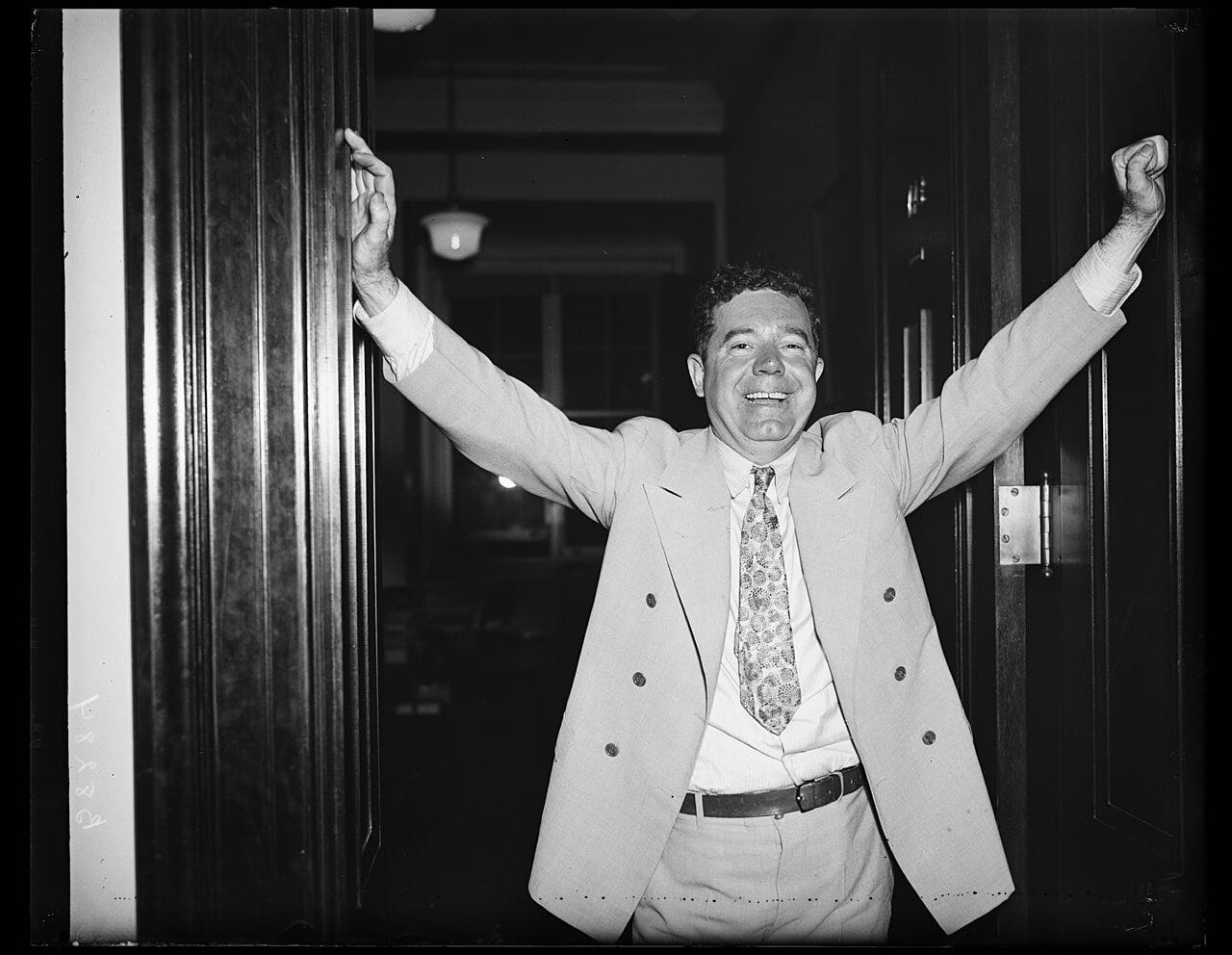
Vice President J.D. Vance raised some eyebrows at a rally [last Friday] when he alluded to Huey Long, a Louisiana politician from the 1930s who advocated outright socialist positions while using his power to maintain near-absolute control of his state. Vance said:

“The great southern populist—probably most of you in the room don’t know who I’m talking about, but he’s an interesting guy—kind of a crazy guy—his name was Huey Long, and he once said: ‘every man a king’ was the goal of his political program. But no man is a king if their castle is under siege by criminals. No man is a king if they can’t take their family out to dinner without being mugged or having their car jacked.”

Huey Long was a fascinating and larger-than-life character in American history. He was born into poverty, worked his way through school, and eventually passed the bar to practice law in Louisiana. He quickly found a populist niche, attacking big business and cronyism and developing a reputation for fighting for the common man. He was elected governor in 1928 and immediately began consolidating power. Depending on whom you asked, he was either a champion of the little guy or a complete dictator.

One of Governor Long’s first actions was calling a special session of the Legislature to enact a five-cent-per-barrel tax on refined oil in order to fund his social agenda. He accused anyone who opposed the tax of having been bought by the oil companies. Outrage over the proposal and his rhetoric drove legislators toward impeachment, and an attempt to adjourn the special session before a vote led to a brawl on the House floor. With his political future in the hands of the Senate, Long garnered enough support to avoid conviction, and the session disbanded without an ultimate vote.

Surviving impeachment only made Long more powerful than his enemies could possibly have imagined. He ran for U.S. Senate in 1930, winning with 57.3% of the vote. However, he refused to leave the governor’s office and occupied both seats for more than a year. He feared that if he resigned the governorship, his lieutenant governor, Paul Cyr, would undo his populist reforms. In fact, Cyr attempted to declare himself the acting governor when Long visited Mississippi in October 1931, but Long ordered National Guard troops to surround the Capitol to put down what he called a coup attempt. A court later agreed with Long that Cyr had illegally tried to seize power and expelled him from his seat.

According to historian T. Harry Williams, “the secret of Long’s power, in the final analysis, was not in his machine or his political dealings but in his record—he delivered something.” Under Huey Long’s administration, Louisiana constructed roads, bridges, hospitals, schools, and a new capitol building that remains the tallest in the fifty states. He invested a lot of taxpayer dollars in Louisiana State University, turning it into one of the top schools in the South.

He also ordered LSU to expel students who criticized him in the student newspaper, which is the flip side of the coin when it comes to populist dictators like Huey Long.

Long supported Franklin D. Roosevelt in the 1932 presidential election, but by 1935 he believed his New Deal programs didn’t go far enough. Long wanted to use socialist ideas to fix the Great Depression, including a 100% tax on earnings over $1 million and a cap on accumulated wealth over $100 million. He called it the “Share Our Wealth” plan and promised a basic universal household grant of $5,000 to start, followed by an annual income of one-third the national average. He promised free college and vocational training, subsidies for farmers, old-age pensions, mandatory vacation, a 30-hour workweek, and more. He promised that every man would be a king.

Roosevelt began to fear that Long would challenge him from the left in the 1936 election and began voicing support for programs such as Social Security to try to blunt Long’s populist appeal. History, however, would take the problem off the table. Carl Weiss, the son-in-law of a Louisiana judge whose district was being gerrymandered out of existence, walked up to Huey Long at the Capitol in Baton Rouge and shot him once in the chest. A day and a half later, the Kingfish was dead.

image 7
Huey Long in 1935. Public domain.

I find Huey Long to be a fascinating historical figure, though of course I disagree with nearly all of his policy positions. His career shows how socialists can seize populist issues to gain political power. Unlike some left-wing populists, Long accomplished things for his constituents, but at a terrible cost. Americans have always known that poverty and hard times are breeding grounds for communism and socialism, which is why we poured billions of dollars into Europe via the Marshall Plan after World War II to ensure communism did not gain a foothold in Greece, Italy, or West Germany. It was the equivalent of U.S. Army Surgeon General William Gorgas clearing the swamps of Panama to eliminate mosquitoes carrying yellow fever and malaria.

Some on the right have thrown the baby out with the bathwater, believing that recognizing the problems with poverty and hard times is akin to advocating for socialism itself. Some free-market conservatives have been attacking Vice President Vance for expressing sympathy with young people today who find the American Dream increasingly out of reach. “Just let the market work,” they say, forgetting that we haven’t had a truly free market in America for generations. We can recognize the problem without adopting the left-wing solutions advocated by men like Huey Long or Bernie Sanders.

This is exactly what Vance was doing in that speech yesterday. He recognized the struggles facing young Americans today and recognized that the obstacles in their path are not the same obstacles faced by previous generations. Our government has imposed innumerable barrier over the past century, from mass migration to DEI policies to the welfare state, each of which makes the American Dream that much harder for hardworking young people to achieve.

Removing these barriers is not “government overreach.” Securing our borders, cracking down on companies hiring foreign workers instead of Americans, eliminating DEI requirements, and reducing the confiscatory taxation necessary to support an expanding welfare state are not the same things as imposing wealth taxes, capping incomes, and overregulating free enterprise. Yet to the free-market critics of men like J.D. Vance, they’re the same picture.

Yesterday’s announcement by President Donald Trump regarding beef imports perfectly demonstrates the paradigm at play here. American beef prices are sky-high right now, and ranchers say it will take years to rebuild American cattle herds after the mismanagement and overregulation of the Biden administration. Americans are suffering (I’ve been buying more ground turkey for my family than ground beef lately), so Trump took action to eliminate tariffs on ground beef for the next three months. Ranchers are outraged, and even Congressman Thomas Massie denounced the plan, despite having opposed tariffs in the past. I suppose in his case, libertarian principles long ago gave way to simply being reflexively anti-Trump.

You surely see the conundrum here: American ranchers want high prices—after all, they have mortgages to pay and families to feed. Yet regular Americans have families to feed as well, which is harder to do when the cost of food is going up along with everything else. This is just the sort of populist moment that left-wing demagogues can seize upon to advance their own power. A Bernie Sanders, Zohran Mamdani, or Alexandria Ocasio-Cortez would suggest that the problem is greedy ranchers and beef processors, and the answer is high taxes, more regulation, or perhaps even just nationalizing the industry altogether.

President Trump didn’t do that. He relaxed import duties for a set period, with the express goal of allowing American ranchers more time to increase supply. It makes sense to me.

When generations face a moment of crisis, they care less about ideological purity than they do about solving the problems at hand. We understood this in 1948, when we sent billions of dollars to rebuild Europe lest those war-weary and impoverished populations turn to the communist banner. We seem to have forgotten it today, as we tell millions of young Americans that they are to blame for their situation and that they must simply pull themselves up by their bootstraps despite the way in which the game has been rigged against them.

Simply repeating “socialism sucks” is not going to stop the specter that is haunting America. We must remove the barriers that government has placed in front of young people and allow the free market to work rather than giving it lip service while ignoring the reality of the situation. J.D. Vance understands this at a much deeper level than most politicians, having grown up in the wreckage of outsourcing, decline, and economic despair. In the same speech in which he invoked Huey Long, Vance pointed out that Democrats like former Ohio senator Sherrod Brown pretend to be the friend of the working man while supporting policies—such as mass migration—that undermine American workers at every turn.

There is no third way in front of us. We either follow Vance’s lead, or we open the door for a modern Huey Long who will promise young people everything they’ve ever dreamed of, the cost of which they won’t know until it’s too late.

About Brian Almon

Brian Almon is the Editor of the Gem State Chronicle. He also serves as Chairman of the District 14 Republican Party and is a trustee of the Eagle Public Library Board. He lives with his wife and five children in Eagle.

Editor’s note:  This article originally appeared in the Gem State Chronicle.  I encourage our readers to visit their website and consider subscribing.  Find this and other informative articles at the Gem State Chronicle here: About – Gem State Chronicle

Idaho Secretary of State: What We Inherit

0

(Idaho Secretary of State, August 21, 2026)

“Today the challenge of political courage looms larger than ever before. For our everyday life is becoming so saturated with the tremendous power of mass communications, that any unpopular or unorthodox course arouses a storm of protests… Our political life is becoming so expensive, so mechanized and so dominated by professional political and public relations men that the idealist who dreams of independent statesmanship is rudely awakened by the necessities of election and accomplishment.”[1]

That wasn’t written in 2026. Or 2006. It was written in 1957.

And yet, nearly 70 years later, it feels remarkably current. We live in an era of constant motion: information overload, endless busyness, a news cycle that never lets a thought finish forming. When do we actually pause? Sit with a hard question? Grapple with something bigger than the topic of the moment?

I struggle with this constantly.

That is why when I was given the opportunity to participate in the Rodel Fellowship, which brings together 24 state and local elected officials from across the country, evenly divided between the political parties, for a series of seminars over two years, I jumped at the chance. The point isn’t to debate the latest political issue. It is to step away from the noise and wrestle with bigger questions of leadership, public service, and the principles we have inherited.

Maybe it’s the philosophy major in me, but I relished the chance to dig into Aristotle, Machiavelli, Kant, George Washington, Frederick Douglass, Abraham Lincoln, Martin Luther King Jr., and others. Kennedy’s Profiles in Courage, quoted above, was among the readings. Our conversations ranged from the origins and principles of our system of government to ethics, religion, polarization, resilience, and more.

There was something powerful about having the time and space to explore those questions with elected officials from different places, levels of government, and political perspectives, to listen, challenge our assumptions, and wrestle seriously with ideas people have been debating for centuries.

It was also an important dose of humility.

Our lives can become consumed by whatever is immediately in front of us. The next election. The next controversy. The next deadline. But spend time with these texts and you quickly realize that many of the questions we think are uniquely ours aren’t unique at all.

We are a small part of a much longer human story.

At the same time, we have inherited something extraordinary. Our constitutional system of self-government has been built, tested, debated, defended, and improved upon by generations before us. We don’t own it. For a time, we are simply its stewards.

That carries an obligation. We cannot responsibly carry forward an inheritance we haven’t taken the time to understand. And we cannot become better leaders if we only spend time with people and ideas that reinforce what we already believe.

I’m grateful for the people who shared this experience with me and for the chance to spend a little less time reacting to what is immediately in front of us and a little more time considering what we have been entrusted with.

That may be one of the most important responsibilities of public service.

Phil McGrane

ABOUT SECRETARY PHIL McGRANE

Phil McGrane was elected Idaho’s twenty-eighth Secretary of State and took office on January 2, 2023. McGrane served as elected Clerk of Ada County from 2019-2022.McGrane holds a bachelor’s degree in philosophy, a juris doctorate, and a Master of Public Administration. As a fourth-generation Idahoan, Phil has dedicated his career to making elections in the state of Idaho accessible, secure and transparent.

Labrador Letter – Grizzly Bears and Who Manages Idaho

0

August 21, 2026 (Cover Photo Credit: Karyn Simmons)

Dear Friends,

Raul Labrador (Photo Credit: Raul Labrador FB)

The grizzly bear is one of the most emblematic animals of the Mountain West, and it is a perfect example of the federal government continuously overreaching into state affairs and management.  The Endangered Species Act (ESA) has been a frequent vehicle bringing federal bureaucracy into states, particularly in the West.  Spotted owls, wolves, salmon – each one with stifling regulation and economy-collapsing rules.

Grizzly bears were listed as a protected species in 1975. Fifty years later, the grizzly population has grown, and the bears have naturally pushed into areas where Idahoans live, work, and recreate. That expansion comes with public safety risks, damage to private property and livestock, and a heavy management burden on our state agencies and local communities.

Rulemaking to revise that 1975 listing is in progress right now. But in the meantime, we are stuck with a federal rule that governs what Idaho can and cannot do about the bears. The Trump Administration recently proposed a new version of that rule, with the stated goal of cutting needless federal bureaucracy and giving states more flexibility. I applaud that goal. However, this week I sent formal comments to Interior Secretary Doug Burgum and Fish and Wildlife Service Director Brian Nesvik explaining why the proposal does not yet get there.

As currently written, the proposal makes the paperwork and bureaucracy worse instead of better, and it hands more opportunities to the activist litigation machine that has been suing Idaho over wildlife management for years. That machine is already well-funded at taxpayer expense. A rule full of vague standards and multi-step approval processes is a gift to the environmental activist lawyers filing continuous lawsuits.

Here is one striking example: The proposal builds a new tier of restrictions around the idea that a grizzly bear might get caught in a trap set for another animal. The data says otherwise. Decades of year-round coyote trapping in Idaho, Montana, and Wyoming produced no grizzly capture or injury. Neither did the expansion of Idaho’s regulated wolf trapping seasons since 2011. Not one documented grizzly capture in a lawfully set trap. Zero.

So where did this manufactured concern come from?  It first appeared in the Fish and Wildlife Service’s 2024 assessment, tracking comments from a scientific peer reviewer who was, at the same time, a paid expert witness for Earthjustice, one of the non-profits responsible for the ongoing lawfare. That firm was suing to shut down wolf trapping across roughly half of Idaho. The peer reviewer told the government he had no conflicts of interest. That was clearly not true.

That is at the heart of my letter to the Administration.  These lawsuits pay lip service to actual conservation while serving special interest fundraising and financing a proliferation of lawyers. Every hour my office spends defending against them is an hour and a dollar taken from actual conservation work that produces results.

I asked the Administration for two things above all. (1) Write clear, plain criteria into the rule so an Idaho trapper or a state biologist can read it and know what the law requires. And (2), respect the Constitution. Under the anti-commandeering doctrine, Washington D.C. cannot force a state to police its own citizens as the price of avoiding federal liability. The rule should plainly state so.

Much of the public comment already filed in this docket is typical advocacy campaign boilerplate letters that treat Idaho’s agencies and local communities as if they had made no investment or sacrifice in this recovery. Idaho carried this program for fifty years, and we are the ones living with the successful results. We should not be handed even tighter restrictions as the reward.  My office will continue to fight against federal overreach into Idaho’s state affairs and our natural resources.

Best regards,

Image

ABOUT THE OFFICE

The Attorney General’s Office provides legal representation to the State of Idaho. The Attorney General and his deputies represent state agencies and offices, to better the lives of Idahoans.

For more information about the Office, visit our website here.


Pocatello: Road Closure and Traffic Report for Week of August 24, 2026

0
(Photo Credit: City of Pocatello)

August 24, 2026 (Cover Photo Credit: City of Pocatello)

The City of Pocatello’s Road Construction & Traffic Report for the week of August 24, 2026, has been published and may be read here.

Highlights include:

  • Street sweepers are currently performing their regular sweeping schedule.
  • The Street Services crew will be patching potholes and curb lines throughout the City.
  • Traffic Operations crews are repainting crosswalks throughout the City.
  • Crews will be jetting and cleaning sewer mainlines throughout the City.
  • Street Services will be fog sealing streets around the city; the schedule may be seen here.
  • Street Services will be milling and paving sections of E Lewis St. and Pocatello Ave.
  • Work continues on the water mainline replacement project on Gray Ave. and Howard Ave. between West Alameda Rd. and West Eldredge Rd.
  • Park Avenue and the alley east between East Oak Street and Elm Street will be closed late this week and all of next week for water and sewer work.
  • Hiline Road (Jefferson Avenue) between East Griffith Road and Pearl Street will be closed for road base work.
  • Demolition of the Monarch Building continues.
  • Work continues on the Benton Street Bridge over the Portneuf River. West Benton Street remains closed between South Hayes Avenue and South Grant Avenue. Construction is anticipated to be finished by the end of September, weather and other unforeseen conditions permitting.
  • South Garfield Avenue between Center Street and West Lewis Street will be closed from 2 PM to 9 PM on Mondays for Curbside Cravings.
  • South Garfield Avenue between Center Street and West Lewis Street will be closed from 2:00 PM to 9:00 PM on Wednesdays for the Bannock Civitan Club’s Revive @ 5 Summer Concerts.
  • South Garfield Avenue between Center Street and West Lewis Street will be closed from 6 AM to 3 PM every Saturday for the Portneuf Valley Farmers Market.

Help Wanted: Bannock County

0

(Bannock County HR, August 21, 2026)

Court Supervisor – Deputy Clerk
Bannock County – Pocatello
Read the full job description:  CLICK HERE!

Equipment Operator 2 – McCammon
Bannock County – McCammon
Read the full job description:  CLICK HERE!

Maintenance Technician, Level 2
Bannock County – Pocatello
Read the full job description:  CLICK HERE!

Emergency Management Director
Bannock County – Pocatello
Read the full job description:  CLICK HERE!

On-call Juvenile Detention Deputy
Bannock County – Pocatello
Read the full job description:  CLICK HERE!

Deputy Sheriff – Detention
Bannock County – Pocatello
Read the full job description:  CLICK HERE!

Deputy Prosecuting Attorney
Bannock County – Pocatello
Read the full job description:  CLICK HERE!

Juvenile Probation Officer
Bannock County – Pocatello
Read the full job description:  CLICK HERE!

For a complete list of available jobs… please visit our career site at: https://bannockcounty.applicantpro.com